Saber Defense • Helix Swarm™
HELIX™ SWORD
The offensive role of the Helix Swarm dual-role attritable flying drone
Build the Web. Own the Sky.
1,500-drone packages organized as 5 × 300-drone hierarchical clusters (MASAC commander + MADDPG executors) penetrate, saturate, and prosecute high-value targets 100–300 km behind contested lines. ≤5 kg, 1200 mm wingspan, 12–20 hr loiter, tube/canister-launched. Same airframe as Helix Shield — toggled by effector cartridge and MARL policy.
Company Vision
“To become the preeminent U.S. provider of autonomous attritable swarm systems by delivering unmatched endurance, decentralized intelligence, vertical integration, and mission adaptability — redefining the future of tactical and operational advantage for the U.S. and its allies.”
THE MISSION
Deliver physics-limited offensive dominance through hierarchical MARL — one airframe, two roles, brigade-scale effects.
Penetrate & Saturate
1,500-drone packages organized as 5 × 300-drone hierarchical clusters overwhelm enemy air defenses through coordinated saturation, decoy feints, and dynamic re-tasking — all without external C2.
Deep-Strike HVTs
Hierarchical MARL (MASAC commander + MADDPG executors) autonomously identifies, prioritizes, and destroys high-value targets and command nodes 100–300 km behind contested lines.
Exhaust Adversary Defenses
Emergent self-sacrifice tactics force the defender to expend $1M–$3M interceptors against $49K–$59K attritable Helix Swarm drones. The cost-exchange ratio is permanently inverted.
Same Airframe as Shield Role
Identical airframe, ASIC, mesh, and AeroHydroCell as Helix Shield. The only difference is the effector cartridge loaded and the MARL policy assigned at mission planning.
HELIX SWARM PLATFORM — SWORD CONFIGURATION
Identical airframe to the Shield role. The Sword configuration loads offensive effector cartridges and assigns hierarchical MARL policies for penetration and strike.
Hierarchical MARL + Self-Play
MASAC commander policy explores tactics; MADDPG executors deliver deterministic precision. MARL-LAC layered autonomy with dual rewards (mission success + survival). Trained in 10,000+ adversarial physics-twin simulations against the Helix Shield itself.
Multimodal Onboard Sensors
EO/IR + RF + acoustic + edge LiDAR + onboard terminal seeker. Same passive multimodal stack as Shield role — re-tasked for target acquisition and BDA instead of threat-web tracking.
Five Hot-Swap Effector Cartridges
90-second tool-less swap on the flight line: HE shaped-charge, EW jammer, ISR/BDA, decoy/spoof, cyber-takeover. Mission-configurable at the cluster level — one airframe, five offensive doctrines.
16nm SNN ASIC + FPGA Bridge (Phase I; 7nm ASIC Phase II)
~9 W average inference, ≤6 ms decision latency. Hybrid ANN-SNN handles terminal guidance and collision avoidance with 3–5× lower power than dense ANN-MARL. Zero dependence on GPS or external C2.
Post-Quantum Mesh + Tube Launch
ML-KEM-768 + ML-DSA-65 + AES-256-GCM mesh for theater-scale offensive coordination. Launched directly from ground tubes, naval canisters, or airdrop pods — no fixed ground infrastructure required.
U.S. Production at Scale
$49K–$59K ASP, ~$8.5K COGS at Y5 scale (≥ $7,900 floor). 10,000 drones/year at Y5 from a single U.S. line; 60,000/yr at multi-site Arsenal scale (Phase II/III reference). 100% sovereign vertical integration — airframe, ASIC packaging, AeroHydroCell, integration.
≤5 kg
Mass
Attritable, tube/canister-launched
1200 mm
Wingspan
Folded for canister stowage
100–300 km
Range
Per-drone operational radius
12–20 hr
Loiter
AeroHydroCell v2.0 boosted
$49K–$59K
ASP
Y1 → Y5 average selling price
300×5
Cluster
1,500-drone hierarchical package
MODULAR EFFECTOR CARTRIDGES
One airframe. Five mission-configurable cartridges. Tool-less field reconfiguration in under 90 seconds — a tactical flexibility no single-mission FPV or loitering munition can match.
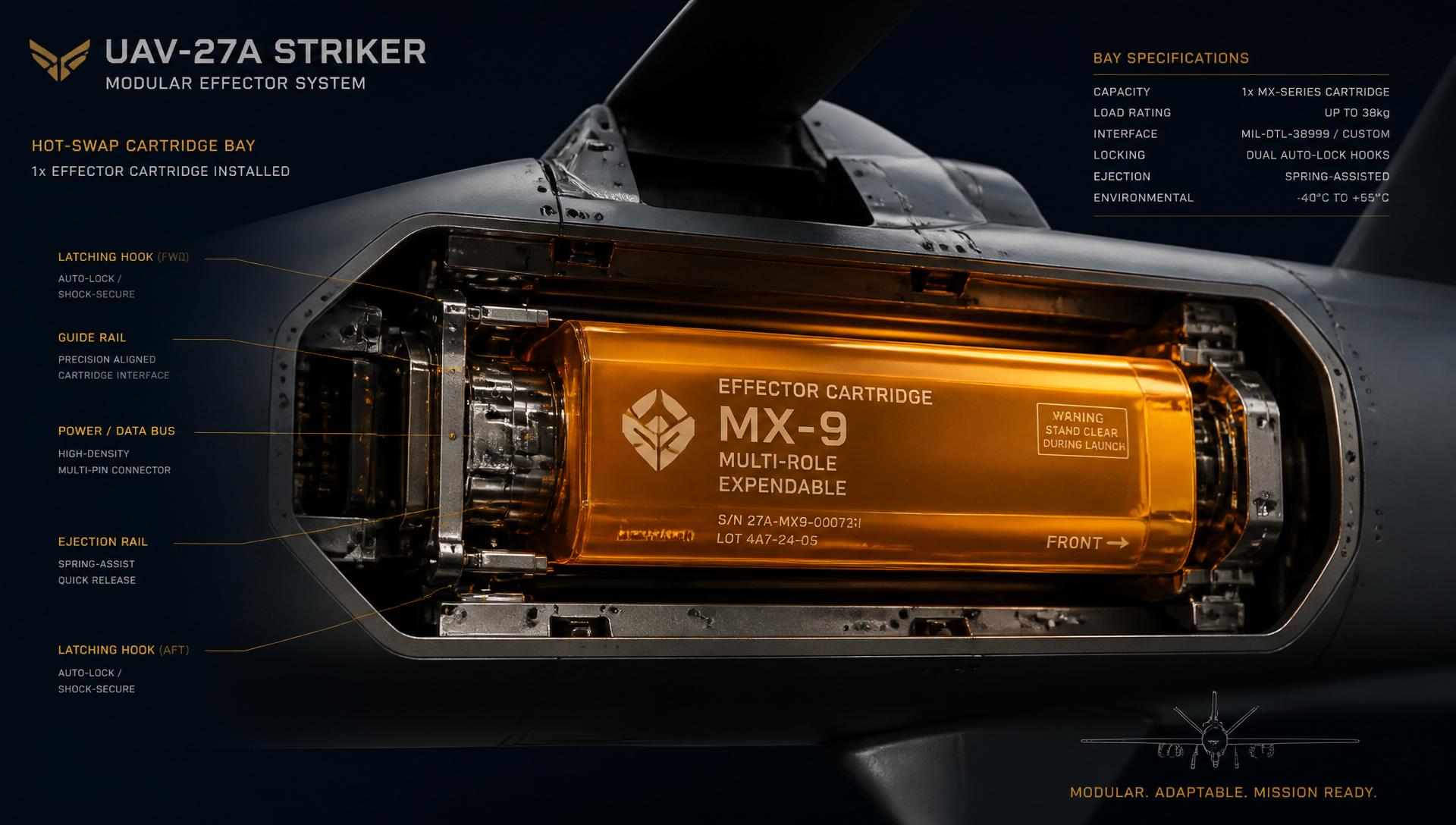
Cartridge Bay Cutaway — Single Cartridge Loaded, Hot-Swappable Mission System
Standard
Kinetic HE
Anti-armor / anti-personnel
Copper-lined shaped-charge with MARL-controlled terminal guidance and impact/proximity fusing.
SEAD
EW / Jammer
Suppress enemy C2 & GPS
High-power RF module with MARL-adaptive frequency hopping driven by real-time sensor fusion.
ISR / BDA
ISR Loiter
Intelligence & damage assessment
EO/IR seeker with encrypted downlink. Extended loiter patterns commanded by hierarchical MARL.
Deception
Decoy / Spoof
Saturate enemy defenses
Radar/IR signature generators with chaff dispensers. MARL coordinates decoy patterns with strikers.
Non-Lethal
Cyber-Takeover
Hijack enemy UAS
Software-defined RF injection enables non-destructive capture of adversary drones for exploitation.
HIERARCHICAL MARL DEEP DIVE
The Helix Sword role fields the same 1,500-drone packages as Shield — organized as 5 × 300-drone hierarchical clusters — but tasked into offensive doctrine:
- MASAC Commander Policy: Stochastic, entropy-regularized — explores creative penetration tactics in self-play training, then commands cluster-level role assignment in flight.
- MADDPG Executor Policies: Deterministic precision for terminal guidance, formation flight, and warhead delivery — distilled from the MASAC commander for low-variance execution.
- MARL-LAC Layered Autonomy: Local autonomy (terminal evasion + intercept) + collaboration layer (cluster coordination + cross-cluster handoff). Survives partial mesh loss.
- Global Reward: HVT destruction success, penetration rate, adversary interceptor exhaustion, mission completion.
- Local Reward: Individual survival until impact, energy efficiency, sensor contribution to swarm awareness.
- Twin Critics: Reduce variance in sparse-reward offensive scenarios where success is binary.
This dual-reward architecture enables emergent self-sacrifice — agents voluntarily absorb interceptors to create openings for strike elements.
Helix Sword swarms train in 10,000+ parallel physics simulations against the Helix Shield MARL itself. Because both roles share the same airframe, ASIC, and mesh, this self-play produces the most battle-hardened offensive AI in existence — every Sword tactic must beat the world's best defensive web.
- Ray-traced weather, terrain, jamming, adversary DEW/HPM/kinetic models
- Continual online learning adapts deployed clusters in <4 hours to novel defenses
- Distilled to 16nm SNN ASIC + FPGA bridge (~9 W avg) for edge inference at ≤6 ms latency
Through self-play, Helix Sword develops behaviors no human programmer could script:
- Coordinated saturation to exhaust adversary interceptor magazines
- Decoy feints — sub-clusters simulate high-value attacks to draw defensive fire
- Self-sacrifice — individual drones absorb interceptors to create penetration corridors
- Zero-shot adaptation via world models for previously unseen defense configurations
- Dynamic re-tasking — survivors redistribute roles automatically when losses occur
Helix Sword enables a three-phase closed-loop approach against deeply buried, hardened facilities:
- Phase 1 — Search & Localize: Helix Swarm clusters self-deploy 100–300 km into denied terrain with persistent passive sensor webs. Multimodal fusion detects ventilation plumes, rail vibrations, EM emissions — without active emissions.
- Phase 2 — Coordinated Strike: Hierarchical MARL allocates roles across drones with 90-second cartridge swaps — shaped-charge to collapse access points, cyber-takeover to disable internal control, EW to suppress air defenses during the strike window.
- Phase 3 — Closed-Loop BDA & Re-Attack: Real-time BDA flows via PQC-encrypted mesh. MARL self-heals losses and re-tasks for follow-on strikes until internal operations are fully disrupted.
12–20 hr loiter per drone enables 24/7 pressure. AeroHydroCell v2.0 extends endurance in variable-humidity environments without resupply.
Helix Sword dramatically reduces the need for high-risk SOF insertions in contested, GPS-denied environments:
- Attritable Forward Presence: Persistent ISR + strike capability deep in denied terrain — replacing ground teams emplacing sensors or conducting raids.
- Force Multiplication: A single 1,500-drone package delivers brigade-level effects with human-on-the-loop ROE oversight from a remote command post.
- Risk Elimination: Zero personnel exposed to adversary air defenses, terrain, or capture.
- SOF Focus Shift: Helix conducts initial search, mapping, precision strikes, and overwatch — letting SOF focus on high-value exploitation or extraction.
COMPETITIVE LANDSCAPE
Their limitation: Scripted or simple RL autonomy. Individual loitering munitions lack true swarm coordination — each drone operates semi-independently with pre-programmed waypoints.
Helix Edge: True hierarchical MARL with 1,500-drone clusters produces emergent coordinated tactics (decoys, flanking, saturation) that overwhelm any defense. $49K–$59K ASP at volume scale; competitors run $50K–$100K+ without swarm intelligence.
Their limitation: Platform-centric autonomy on V-BAT, CCA, Hornet. Focused on piloting individual aircraft, not mass-attritable hierarchical swarm tactics. GPU-heavy compute; no vertical manufacturing.
Helix Edge: Helix Swarm is a co-designed airframe + 16nm SNN ASIC + FPGA bridge (Phase I; 7nm ASIC deferred to Phase II) + MARL-LAC + AeroHydroCell v2.0. Same platform delivers Shield + Sword roles. Hivemind on a Hornet costs $400K+ per shot; Helix Swarm costs $49K–$59K with 12–20 hr loiter.
Their limitation: High-cost attritable aircraft ($2–20M per unit for CCA; Roadrunner-M is recoverable single-shot). Lattice C2 lacks native swarm AI for mass tactics.
Helix Edge: ~50× more agents at <1/40th the cost. True hierarchical MARL overwhelms with numbers + coordination, not individual platform capability. Economics make brigade-scale strikes viable where CCA cannot.
Helix Swarm is the only single-platform dual-role attritable flying drone with hierarchical MARL at 1,500-drone scale. Competitors remain siloed:
- Same U.S. production line for Shield + Sword → 25–30% cost synergy
- Sword swarms self-play against Shield MARL → battle-hardened from day one
- Shared digital twins, shared ASIC, shared mesh → unmatched development velocity
MARKET & GO-TO-MARKET
DoW attritable autonomy spending: $3–5B FY2026 accelerating to $15B+ by 2030. Replicator 2 explicitly prioritizes mass-producible, AI-coordinated systems. Helix Sword is purpose-built for this exact requirement.
- U.S. Army / Marines: Marine Corps kinetic swarm demos, Army Project Flytrap
- SOCOM: Deep-strike and HVT prosecution in contested environments
- NATO + Indo-Pacific FMS: Allies seeking affordable deep-strike swarm capability
- DARPA: OFFSET extensions and next-gen swarm programs
- ASP: $49K (Y1) → $59K (Y5) per drone
- Cluster Package: 300 drones + sustainment pack
- Phase 1: Replicator 2 OTAs, OFFSET follow-ons, SBIRs
- Phase 2: Prime teaming + FMS exports
RISK MITIGATION
Human-on-the-loop architecture for all lethal decisions. Verifiable ethical AI layers with full audit trails. Compliant with DoW Ethical AI Principles and NATO autonomous-weapons frameworks.
Phased OTA live-fire validation at secured U.S. facility. High-fidelity physics twins with real-world correlation data. Incremental complexity ramp from 10-agent to 1,500-agent operations.
Mitigated by 100% U.S. vertical integration: airframe, ASIC packaging, AeroHydroCell, and final integration. Secured U.S. facility handles warhead loading and live-fire only. Sovereign U.S. supply chain throughout.
ROADMAP — Y1 → Y5
Y1 (2026)
Prototype
- U.S. R&D + manufacturing line stand-up
- Secured U.S. facility — warhead loading + live-fire range online
- 1,500 units produced (single-line) · $73.5M revenue
- v1 Helix Swarm prototype + 100-agent hierarchical MARL flight tests
Y2 (2027)
Validation
- JIATF-401 OTA live-fire (Sword + Shield roles)
- First pilot orders (Marine Corps + SOCOM)
- 3,500 units produced · $180M revenue
- First full 1,500-drone hierarchical cluster live-fire · segment EBITDA positive ($18M)
Y3 (2028)
Production
- Single-line: 6,500 units · $351M revenue
- Multi-cluster offensive doctrine validated at brigade scale
- Prime teaming partnerships active
- Tranche B draw trigger: first OTA contract closed at secured facility (unlocks Phase II $95M)
Y4 (2029)
Evolution
- 8,500 units · $480M revenue · 3-shift cadence
- Hierarchical MARL v2 + zero-shot penetration tactics
- NATO FMS pipeline + Indo-Pacific exports
Y5 (2030)
Full Rate (Base Case)
- Single-line full rate: 10,000 units / yr · $590M revenue · 85.6% gross margin
- 220 FTE steady-state · 6-min takt across 3 shifts
- Full-spectrum prime contractor status
- Multi-site Arsenal upside (Phase II/III, reference only): 60,000 units / $5,340M
DoW REPLICATOR PROGRAM
The Department of War's flagship initiative to rapidly field thousands of low-cost, attritable, autonomous systems — and the strategic tailwind powering Helix.
~$1B
Initial Funding
FY2024–2025 allocation
18–24mo
Sprint Timelines
Concept to fielding
JIATF-401
C-sUAS Lead
Replicator 2 organization
FY2026
Funding Decision
Full Replicator 2 budget
Program Overview
Launched August 28, 2023, by then-Deputy Secretary of Defense Kathleen Hicks, Replicator was designed to counter China's massed uncrewed systems advantage in the Indo-Pacific by changing the economics and speed of acquisition.
- Attritable Autonomy (ADA2): Low-cost, expendable systems manufactured at scale. "Mass" over exquisite performance — swarms that overwhelm through quantity, software-driven collaboration, and rapid iteration.
- All-Domain: Air, maritime (surface/sub-surface), land, and enabling software across all domains.
- Acquisition Speed: Bypass traditional slow procurement via DIU-led tranches, OTAs, and reprogramming to field capabilities in 18–24 months.
- Software-First: Emphasis on autonomy, C2, collaboration, and lethal effects — not just hardware.
Goal: Field "multiple thousands" of ADA2 systems by August 2025 (18–24 month sprint).
Tranches:
- Replicator 1.1: AeroVironment Switchblade 600, Anduril Altius-600/Ghost-X UAS, Performance Drone Works C-100, uncrewed surface vehicles, and initial C-UAS assets.
- Replicator 1.2: Maritime systems (Anduril Dive-LD AUVs), additional air-domain platforms, and integrated software enablers for autonomy, resilience, and swarm collaboration.
Status (March 2026): Hundreds of systems delivered and transitioned to warfighters by August 2025. Software layer selected from Aalyria, Viasat, Higher Ground, and IoT/AI providers. Focus shifting to end-user adoption by services and SOCOM.
Announced September 27, 2024 via Secretary Lloyd Austin memo — shifts focus to countering the small UAS threat to critical assets and force concentrations.
- JIATF-401: Consolidated into the Joint Interagency Task Force 401 (August 2025) as the lead organization for C-sUAS development and acquisition across DoW.
- First Buy (Jan 2026): JIATF-401 awarded contract for two Fortem Technologies DroneHunter F700 AI-powered interceptor systems (delivery by April 2026) — the initial operational buy under Replicator 2.
- Low-Cost Sensing Challenge: 10 finalists (BLUEiQ, CHAOS 1, Fortem, Guardian RF, Hidden Level, MatrixSpace, REVOBEAM, Squarehead, Teledyne FLIR, Thalrix) for distributed sensing. Live demos at NORTHCOM Falcon Peak.
- Timeline: Deliver "meaningfully improved C-sUAS protection" within 24 months of Congressional funding approval (FY2026).
- Initial Funding: $500M FY2024 (reprogramming) + $500M requested FY2025 = ~$1B over two years.
- FY2026: Senate has recommended full funding; Replicator 2 line items part of pending budget request.
- CRS Issues (Jan 2026): Whether to approve/modify funding; adequacy of information for oversight; transition from prototype to programs of record.
Now often referred to with a secondary "Department of War" designation under Executive Order 14347. Congress continues to debate oversight and specific capability details.
Primary Threat Driver: China's rapid uncrewed systems buildup and mass production advantage in the Indo-Pacific.
Progress: Officials highlight accelerated acquisition, software collaboration, and hundreds fielded. Replicator has driven cultural change — iterative risk tolerance, commercial integration, and software-centric lethality.
Evolution: Transitioning from DIU-led prototype effort to service/SOCOM execution. Moving from concept to hundreds fielded (Replicator 1) and first operational C-sUAS buys (Replicator 2), with FY2026 funding decisions imminent.
Helix × Replicator Alignment
Helix Offensive SWARM aligns directly with Replicator 1's vision: attritable autonomous offensive systems with swarm collaboration software and lethal effects in dynamic environments.
- U.S.-manufactured MARL-powered attritable Helix Swarm drones can compete in future tranches for air/maritime/land offensive roles.
- Target Replicator 1.2 software/autonomy selections with hierarchical MARL offensive capabilities.
- Leverage 18–24 month sprint timelines for rapid prototyping and fielding demos.
Saber's dual-role Helix ecosystem — defensive MARL-LAC webs + offensive hierarchical MARL swarms on a single airframe — is uniquely positioned to capture significant share in both Replicator phases from a single secured U.S. manufacturing campus. Shared IP and training twins create cross-tranche advantages no competitor can match.
This program is the strategic tailwind that accelerates Helix to prime-contractor status and the $316M+ consolidated revenue target by 2030.